
“Scent” or “Odor” in Japanese kanji, and the Stroke Order and Meanings of Kanji “薫”
Japanese Jouyou-kanji “薫” means “Aroma”, “Pleasant smell” or “Be influenced” etc.

Jouyou Kanji “薫”
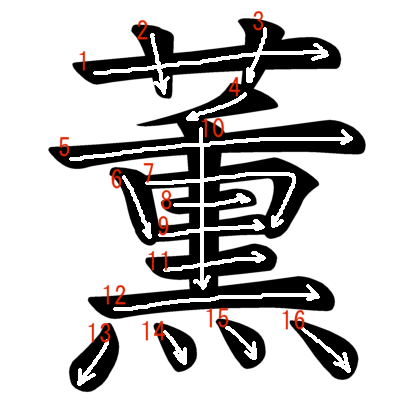
Jouyou Kanji “薫” Stroke Order
| Stroke # | 16 Strokes |
|---|---|
| On-Yomi | くん(kun) |
| Kun-Yomi | かお(る)(kao(ru)) |
| かおりぐさ(kaorigusa) | |
| た(く)(ta(ku)) | |
| Meanings | Tulsi(Holy basil) |
| Smell, Fragrant, Odor, Scent | |
| Fumigate, Smoke, Smolder | |
| Under the influence of, Be influenced, Be affected |
Kanji words which contain Kanji “薫”, and their meanings
| Words | Meanings |
|---|---|
| 薫育(くんいく-ku n i ku) | Moral influence, Moral education, Teaching and guiding with virtue |
| 薫化(くんか-ku n ka) | Influencing people by one’s virtue, Leading people to the better way by virtue |
| 薫香(くんこう-ku n ko u) | Aroma, Incense, Fragrance, Scent |
| 薫製 or 燻製(くんせい-ku n se i) | Smoked meat or fish, Smoked food |
| 薫染(くんせん-ku n se n) | Good influence |
| 薫陶(くんとう-ku n to u) | Influencing and educating people with virtue, Training, Education |
| 薫風(くんぷう-ku n pu u) | Balmy breeze, Early summer breeze with a fresh green scent |
| 薫灼(くんしゃく-ku n sha ku) | ① Bake it smoldering, ② Make people suffering and worrying |
| 薫蕕(くんゆう-ku n yu u) | ① Good smell and bad smell, ② Good person and bad person |
| 余薫(よくん-yo ku n) | Olfactory training device, Lingering odor |
| 空薫(そらだき-so ra da ki) | To burn incense in advance so that it comes out of nowhere, Burning incense without making its source obvious, Pleasant smell coming from an unknown location |

Comments