
“Theory” or “Opinion in Japanese kanji, and the Stroke Order and Meanings of Kanji “説”
Japanese Jouyou-kanji “説” means “Tale”, “Thought” or “Explain” etc.

Jouyou Kanji “説”
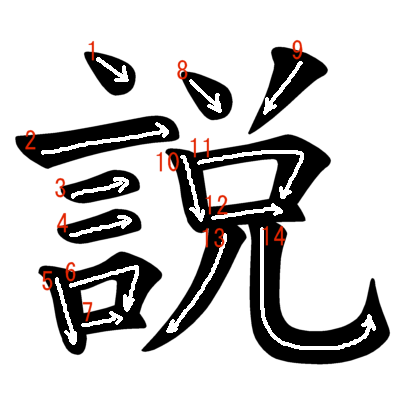
Jouyou Kanji “説” Stroke Order
| Stroke # | 14 Strokes |
|---|---|
| On-Yomi | せつ(setsu) |
| ぜい(zei) | |
| えつ(etsu) | |
| せい(sei) | |
| Kun-Yomi | と(く)(to(ku)) |
| よろこ(ぶ)(yoroko(bu)) | |
| Meanings | Explain, Interpret, Talk, State, Mention, Admonish |
| Opinion, Thought | |
| Tale, Story | |
| Oath words | |
| Persuade | |
| Rejoice, Be happy, Be glad | |
| Obey, Follow, Submit |
Kanji words which contain Kanji “説”, and their meanings
| Words | Meanings |
|---|---|
| 説教(せっきょう-se kkyo u) | Sermon, Preaching |
| 説経(せっきょう-se kkyo u) | Lecture on the sutras, Preach |
| 説述(せつじゅつ-se tsu ju tsu) | Explaining, Exposition, Explanation, Description |
| 説得(せっとく-se tto ku) | Persuasion, Conviction |
| 説破(せっぱ-se ppa) | Confuting, Arguing down |
| 説伏(せっぷく-se ppu ku) | Persuasion |
| 説法(せっぽう-se ppo u) | Preaching, (Buddhist) sermon |
| 説明(せつめい-se tsu me i) | Explanation |
| 説文(せつもん-se tsu mo n) | Explaining the original meaning and composition of Kanji |
| 説諭(せつゆ-se tsu yu) | Admonition, Persuasion, Convincing |
| 説話(せつわ-se tsu wa) | Narrative, Tale, Folk-Literature, Traditions |
| 異説(いせつ-i se tsu) | Different opinion, Different view |
| 一説(いっせつ-i sse tsu) | Another view, Another opinion, According to one theory |
| 演説(えんぜつ-e n ze tsu) | Speech, Address |
| 解説(かいせつ-ka i se tsu) | Commentary, Explanation |
| 学説(がくせつ-ga ku se tsu) | Theory, Doctrine |
| 旧説(きゅうせつ-kyu u se tsu) | Old theory, Ancient ideas |
| 口説(くぜつ-ku ze tsu) | ① Persuasion, Inducement, ② Seducing, Appeal |
| 巷説(こうせつ-ko u se tsu) | Gossip, Talk about town, Rumor |
| 高説(こうせつ-ko u se tsu) | Your excellent opinion, Lofty views |
| 講説(こうせつ-ko u se tsu) | Explanation by lecture, Lecturing |
| 細説(さいせつ-sa i se tsu) | Tell-tale, Weakly based information, Boring accusation, Petty accusations |
| 社説(しゃせつ-sha se tsu) | Editorial, Column, Newspaper column |
| 小説(しょうせつ-sho u se tsu) | Novel, Fiction |
| 序説(じょせつ-jo se tsu) | Prolusion, Foreword, Preface, Introduction |
| 新説(しんせつ-shi n se tsu) | New theory, New doctrine, New version |
| 総説(そうせつ-so u se tsu) | Summary, Outline, General remarks, Review, Introduction |
| 伝説(でんせつ-de n se tsu) | Tradition, Legend, Folklore, Folk tale |
| 評説(ひょうせつ-hyo u se tsu) | Comment, Commentary, Review, Criticism |
| 弁説(べんせつ-be n se tsu) | To clarify and explain the pros and cons of things |
| 遊説(ゆうぜい-yu u ze i) | Campaign, Stumping |
| 力説(りきせつ-ri ki se tsu) | To assert something with all one’s might |
| 論説(ろんせつ-ro n se tsu) | Editorial, Leading article |

Comments