
“Throw away” or “Damp” in Japanese kanji, and the Stroke Order and Meanings of Kanji “捨”
Japanese Jouyou-kanji “捨” means “Abandon”, “Drop” or “Give alms” etc.

Jouyou Kanji “捨”
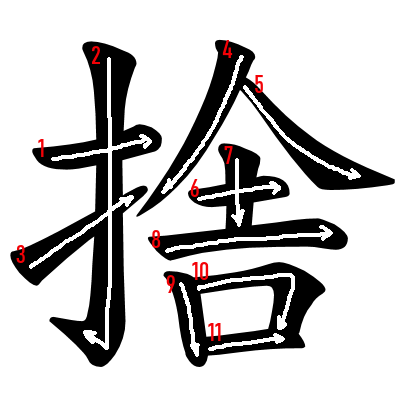
Jouyou Kanji “捨” Stroke Order
| Stroke # | 11 Strokes |
|---|---|
| On-Yomi | しゃ(sha) |
| Kun-Yomi | す(てる)(su(teru)) |
| す(つ)(su(tsu)) | |
| ほどこ(す)(hodoko(su)) | |
| Meanings | Throw away, Dump, Desert, Abandon |
| Leave alone | |
| Give alms, Donate some things to temples or shrines |
Kanji words which contain Kanji “捨”, and their meanings
| Words | Meanings |
|---|---|
| 捨象(しゃしょう-sha sho u) | Abstraction |
| 捨身(しゃしん-sha shi n) | ① Renouncing the flesh or the world, Becoming a priest, ② Sacrificing one’s life for the sake of mankind or Buddhist teachings, ③ Risking one’s life for others |
| 捨て石(すていし-su te i shi) | ① Sacrifice stone (in go game), ② Ornamental garden stone (placed to give a natural appearance), Garden rock, ③ Stones used in a foundation, Riprap |
| 捨て売り(すてうり-su te u ri) | Sacrifice sale, Dumping, Selling dirt-cheap |
| 捨て小舟(すておぶね-su te o bu ne) | ① Drifting boat, ② Nobody pays attention, Lonely person |
| 捨て書き(すてがき-su te ga ki) | Write and leaving it somewhere, To write carelessly |
| 捨て仮名(すてがな-su te ga na) | Small okurigana used with kanbun |
| 捨て金(すてがね-su te ga ne) | Wasted money, Money thrown away |
| 捨て言葉(すてことば-su te ko to ba) | Malicious words said to intimidate or belittle someone when parting, Words spoken without expecting a response when parting a person |
| 捨て台詞(すてぜりふ-se te ze ri fu) | ① Parting shot, Parting remark, ② A short line that the actor improvises according to the atmosphere of the place even though it is not written in the script |
| 捨て値(すてね-su te ne) | Giveaway price, Sacrifice price |
| 捨て鉢(すてばち-su te ba chi) | Desperate, Reckless, Desperation attitudes and/or behavior |
| 捨て扶持(すてぶち-su te bu chi) | Small stipend paid to dependants of a bereaved family (Edo period) |
| 捨て身(すてみ-su te mi) | Putting one’s life on the line, Giving everything one has got, Acting out of desperation |
| 喜捨(きしゃ-ki sha) | Charity, Alms‐giving, Donation, Contribution |
| 取捨(しゅしゃ-shu sha) | Selection, Sorting out, Choice, Adoption or rejection |

Comments